
Table of Contents:
SMS earned its reputation. It's the channel almost everyone opens (studies show around 98% of texts get opened, the majority within three minutes of receipt) and it still drives strong clicks and conversions for brands that use it well.¹ And so we’re on the same page, this isn't a blog post about how SMS is broken. It's a conversation about SMS hitting a ceiling.
That ceiling is the format itself. SMS is a decades-old standard built for 160 characters of plain text from an anonymous number. It's great for visibility but once it's seen, there's very little it can actually do. RCS for Business keeps everything SMS does well and removes that limitation. Here's what makes RCS campaigns more engaging than SMS.
SMS actually works
A fair comparison starts by acknowledging where SMS is genuinely strong. Texts are opened almost universally and almost instantly. Opt-out rates stay low for well-run programs, and aggregate click-through rates sit around 19%, which is generally much higher than email.¹ ² That high-visibility, high-immediacy profile is exactly why SMS remains a core channel.
The limitation isn't attention. It's what happens after that attention is captured.
Where SMS hits its ceiling
While SMS is effective, it has severe limitations:
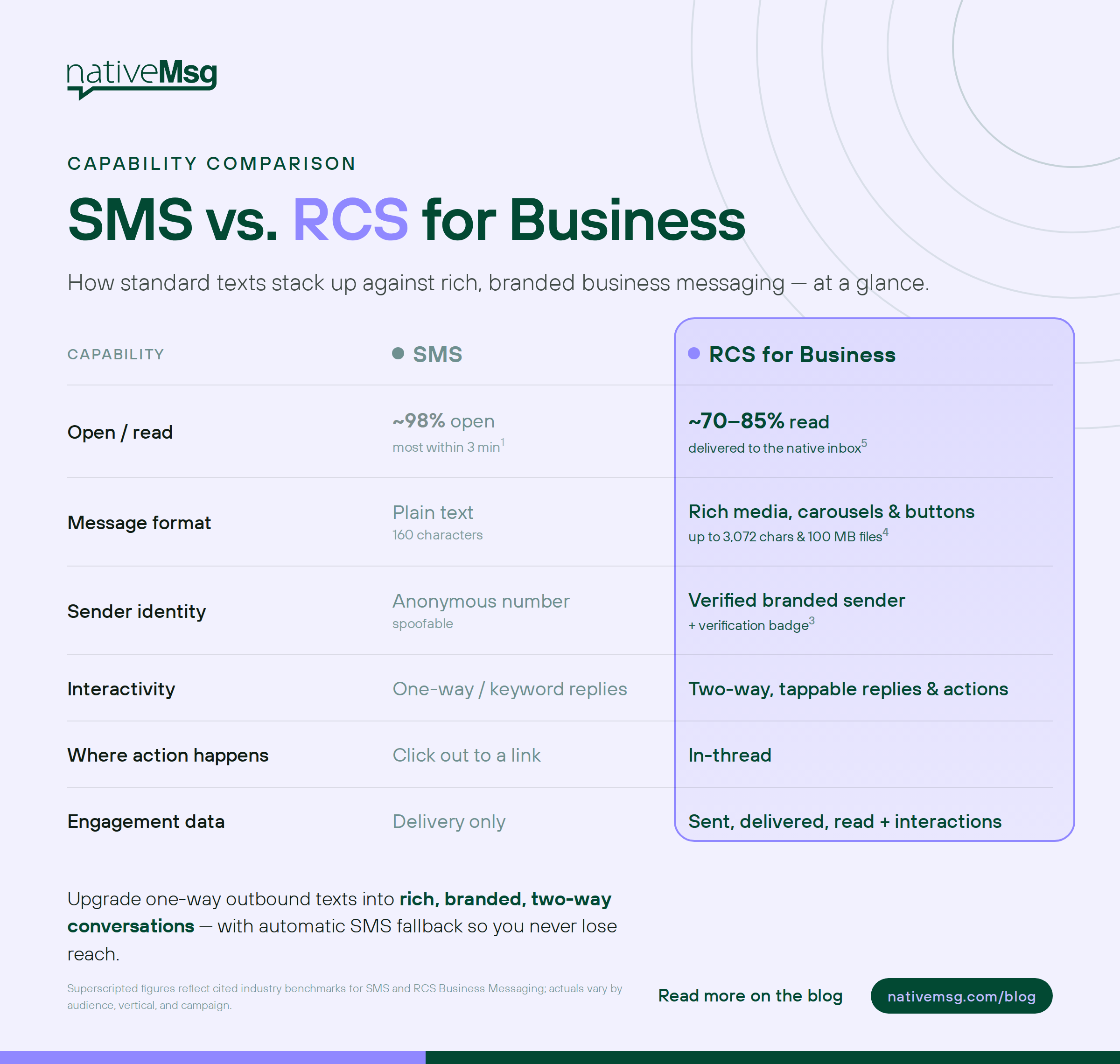
- Plain text only. SMS is capped at 160 characters with no images, video, carousels, or buttons. You can describe a product; you can't show it or let someone tap to buy it.
- An anonymous sender. SMS arrives from a random number or short code with no logo, no name, and no verification — the same look and feel as scammers trying to take advantage and exploit people for profit. This is called "smishing" and it’s tough to combat because senders have no way to verify it’s them, and recipients have no built-in way to confirm that it's really you.
- One-way by design. SMS is mostly a broadcast. Real interaction means clunky keyword replies or, more often, a link that sends the customer out of the conversation to a webpage, where engagement leaks away.
- Thin data. SMS tells you a message was delivered. It can't tell you how someone interacted with it.
SMS gets you in front of the customer, but it can't do much else once it's there.
What RCS adds, and why it's more engaging
RCS for Business runs in the same native inbox as SMS, so it inherits that high-visibility advantage. Then it adds the layers SMS structurally can't:
- Verified, branded identity. Your logo, name, and a verification badge appear on every message. That's not purely cosmetic either — 88% of consumers say they trust a message more when it carries a verified badge,³ and trust is the foundation of engagement.
- Rich, interactive content. Images, video, product carousels, and tappable suggested-reply and suggested-action buttons turn a static text into something a customer can explore and click on. RCS also increases the limits dramatically: up to 3,072 characters and file sharing up to 100 MB, versus SMS's 160 characters.⁴
- True two-way conversation. Instead of pushing customers to click a spam-like link, RCS lets them browse, choose, book, or buy inside the message. By attaching AI tools to your experience, your customers can also ask questions, look for related items, and more by sending texts back.
- Real engagement data. RCS reports sent, delivered, and read, plus how customers interacted, so you can optimize your campaigns easily based on user feedback.
The head-to-head numbers back this up. In direct comparisons, RCS has driven customer engagement roughly 42% higher and click-through rates about 3x higher than SMS,⁴ with RCS read rates commonly reported at 70–85% and conversion rates in the 20–40% range.⁵ Same inbox, far deeper engagement.
SMS vs. RCS for Business, at a glance
The takeaway: RCS is SMS, evolved
You don't have to choose between SMS's reach and RCS's richness. RCS for Business builds on the same native messaging surface, and falls back to SMS when a device doesn't support it. You can keep universal reach while delivering a far richer experience to everyone who can receive it.
SMS answered the question "did they see it?" RCS answers the next one: "did they engage, trust it, and act?" For campaigns where engagement is the goal, that's the difference that matters.
See the difference for yourself. Check out our interactive guide to experience an RCS conversation firsthand (free, no signup required, just a click) or book a demo to see RCS customized to your brand.
Sources
- Optimonk — 43 SMS Marketing Statistics for 2026 (98% open; 90% read within 3 min; ~19–20% CTR). https://www.optimonk.com/sms-marketing-statistics
- MessageFlow — SMS Marketing Benchmarks 2026 (aggregate SMS CTR ~19%). https://messageflow.com/blog/sms-marketing-benchmarks/
- Infobip (citing Datos Insights) — Key RCS Statistics & Market Insights for 2026 (88% trust verified badge). https://www.infobip.com/blog/rcs-statistics
- Sinch — 30+ RCS Statistics (42% higher engagement & 3x CTR vs Rich SMS; 3,072-char & 100 MB limits vs SMS 160). https://sinch.com/blog/rcs-statistics/
- CM.com — RCS Statistics That Will Impress Every Marketer (read 70–85%; conversion 20–40%). https://www.cm.com/blog/rcs-statistics-for-marketers/