
Table of Contents:
AI has transformed customer engagement. It answers questions instantly, personalizes responses in real time, and guides users through complex journeys. At first, engagement looks promising.
Then something happens.
Customers drop off mid-conversation, stop replying, abandon the flow, and never reach the final call to action. When brands investigate, they often assume the AI needs more training or better prompts. But in most cases, intelligence isn’t the issue.
The experience is. This is where RCS for Business steps in.
Why AI Conversations Lose Momentum
Most AI deployments rely heavily on open-ended, text-based interaction. Users are asked what they’re looking for, prompted to explain their needs, and expected to type their way through the journey.
While this feels flexible, it introduces friction. We’ve found that AI conversations typically stall because of three core issues:
- Too much typing
- Too much friction
- Too little visual guidance
Let’s start to unpack that.
1. Too Much Typing
Typing on a mobile device requires effort. The longer the response, the greater the cognitive load. When users are repeatedly asked to type:
- What they’re looking for
- Clarifications
- Follow-up responses
Engagement slows. Every additional keystroke increases the likelihood of drop-off.
2. Too Much Friction
Open-ended prompts create uncertainty:
- What should I ask?
- What does this AI understand?
- Am I using the right wording?
Even highly intelligent AI systems struggle when users feel unsure about how to proceed. Uncertainty disrupts momentum, and momentum is critical in conversational journeys.
3. Too Little Visual Direction
Text-only conversations lack hierarchy and guidance. Long blocks of text make the experience boring, leading to harder decision-making. Without clear options, structured paths, and visible next steps, your users will hesitate — and hesitation leads to eventual abandonment.
The Cognitive Load Problem
Every phone interaction competes for attention, and the competition is fierce. When AI relies on:
- Free-text responses
- Multiple clarifying questions
- Paragraph-heavy explanations
- External links
This increases the mental effort required to complete a task. And when effort outweighs reward, users exit the conversation. Your AI system may be functioning perfectly, but the design of the interaction makes conversions harder than it needs to be.
How RCS Reduces Friction and Drives Conversions
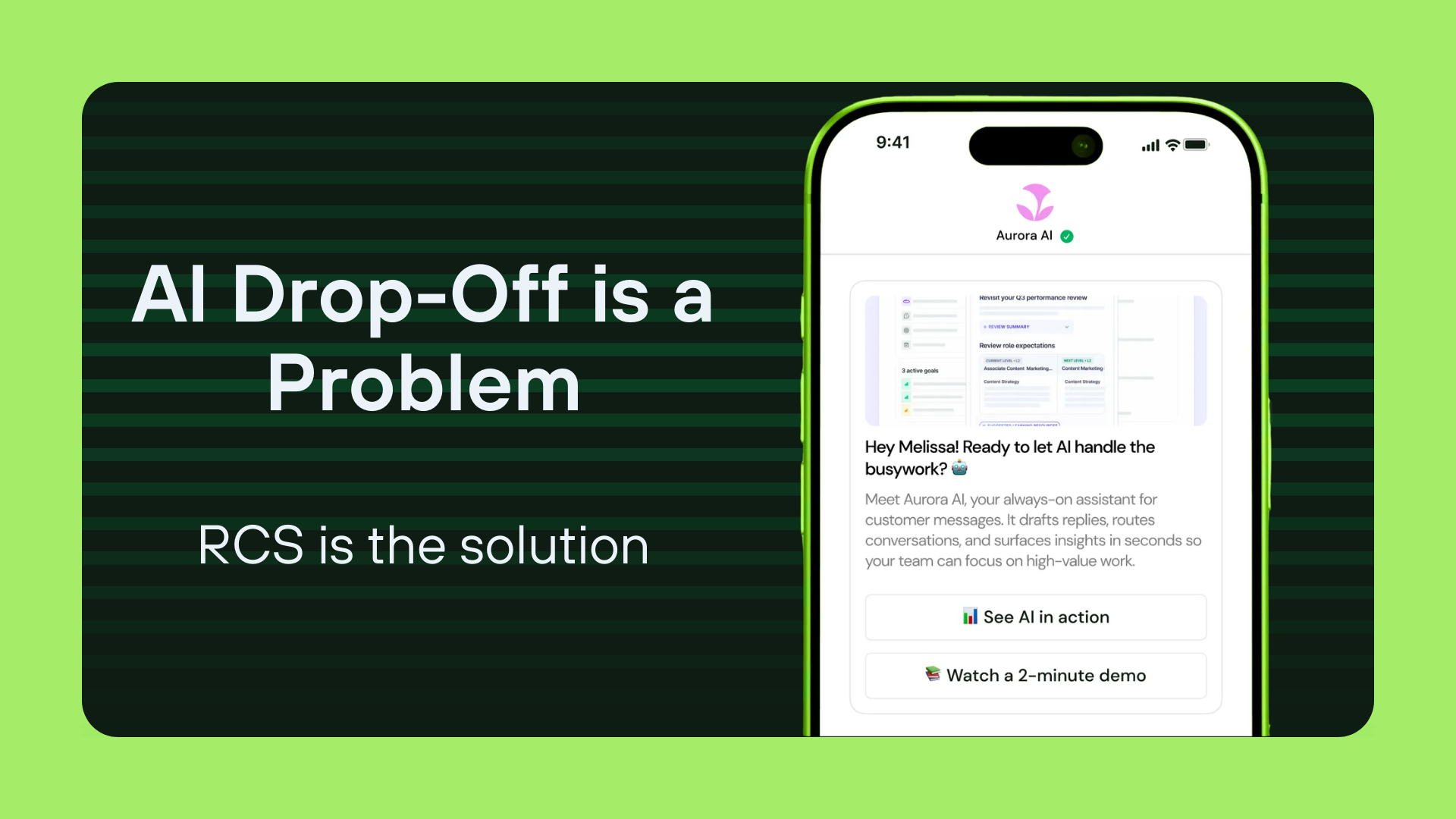
RCS (Rich Communication Services) for Business technology transforms AI from a text-heavy conversation into a guided, interactive experience delivered directly inside the native messaging app. Instead of forcing users to type their way forward independently, RCS enables:
- Tappable, guided suggestions
- Visual decision flows
- Fewer open-ended prompts
- Direct action buttons
This shift significantly reduces cognitive load on customers and increases conversion rates.
From Open-Ended Prompts to Guided Progress
Let’s use a shoe store as an example. A traditional AI interaction might start with:
“Which shoes are you interested in?”
The user must type a response, wait for clarification, and continue typing through the journey. Now imagine the same interaction enhanced with RCS. The opening message can ask the same question, but instead of waiting for the customer to respond, it’ll display clear, tappable options like:
- Men’s Apparel
- Women’s Apparel
- Accessories
- New Arrivals
All featuring pictures, videos, photo carousels, and more. This removes typing requirements, uncertainty, and guesswork. Each tap is built to move the customer forward.
Guided options eliminate friction while preserving personalization. The AI still powers recommendations and logic behind the scenes, but the experience looks and feels intuitive rather than demanding.
Why Structured Messaging Performs Better
RCS messaging improves AI performance for three key reasons:
- Reduced cognitive load → Users don’t have to invent responses. They choose from clear options.
- Faster interaction speed → Tapping buttons is faster than typing.
- Clear next actions → Prominent buttons prevent conversational dead ends.
When users always know what to do next, engagement continues. When they have to think too hard about it, it stops.
Designing AI for Conversions, Not Just Conversations
Many AI deployments are optimized for dialogue. But dialogue isn’t the goal, outcomes are. Whether you’re driving:
- Purchases
- Bookings
- Support resolutions
- Sign-ups
The experience must prioritize clarity and simplicity. AI provides:
- Intelligence
- Personalization
- Automation
RCS provides:
- Structure
- Visual hierarchy
- Guided flows
- Friction reduction
Together, they create conversational experiences that actually convert.
Quick Recap
In summary, if your AI conversations are stalling, the solution may not be a smarter model, it may be a smarter delivery layer.
Less typing → More engagement
Less friction → Higher conversions
Clearer paths → Stronger conversions
AI is definitely a powerful tool, but performance depends on how it’s experienced. And conversions depend on design.
Are Your AI Conversations Stalling?
If customers are dropping off mid-flow, the issue may not be your AI model, it may be your messaging layer. See how nativeMsg helps brands combine AI intelligence with rich, interactive RCS for Business experiences that reduce friction and increase conversions.
Book a free, 30 minute demo today to explore how RCS can optimize your AI engagement strategy.