
Table of Contents:
We’re quickly entering a new phase of the AI era. For the past few years, the conversation has focused on models: how powerful they are, how fast they’re improving, and what they can generate.
But as AI capabilities become more commoditized, a new question is emerging: Where does AI actually show up?
Because in practice, AI doesn’t create value in isolation. It creates value through its interfaces and the places where people interact with it. In this post, we’ll talk about different ways to get your AI in front of your users, and why it matters.
From Model Wars to Interface Wars
Early in the AI cycle, differentiation was driven by model quality.
- Who has the best LLM?
- Who can generate the most accurate outputs?
- Who can scale fastest?
But as models converge in capability, the competitive advantage is shifting.
From:
- What the AI can do
To:
- Where and how the AI is experienced
In other words, we predict that we’re moving from model wars to interface wars.
What Is the Interface Economy?
The interface economy is the idea that distribution and interaction layers determine where value accrues.
We’ve seen this before:
- Mobile apps reshaped software distribution
- Social feeds and algorithms determined content visibility
- Marketplaces controlled buyer-seller interactions
In each case, the winners weren’t just those with the best product, they were the ones embedded in the highest-frequency user interfaces. AI is following the same pattern.
Why Interfaces Matter More Than Intelligence Alone
Even the most advanced AI is limited if:
- Users don’t encounter it regularly/know it exists
- It’s buried behind friction (apps, logins)
- It doesn’t integrate into existing behavior
- It can’t act at the moment of intent
An AI that requires effort to access will always lose to one that’s already where the user is. That’s why interface design and interface placement is now a core strategic decision.
The Rise of Ambient AI
We’re moving toward a world where AI is:
- Always available
- Context-aware
- Embedded in everyday interactions
- Capable of taking action
This is often described as ambient AI (intelligence that doesn’t require users to seek it out.) Instead, it shows up at the right moment, in the right place. But ambient AI only works if it’s delivered through the right interfaces.
Messaging as the Default Interface
Among all possible interfaces, one stands out: Messaging.
Why? Because messaging is:
- High-frequency (checked constantly)
- Native (built into every device, Android and iOS)
- Conversational (aligned with how humans communicate)
- Actionable (increasingly interactive)
It’s already where people coordinate, decide, and take actions. That makes it a natural home for AI.
Why RCS Is Built for the Interface Economy
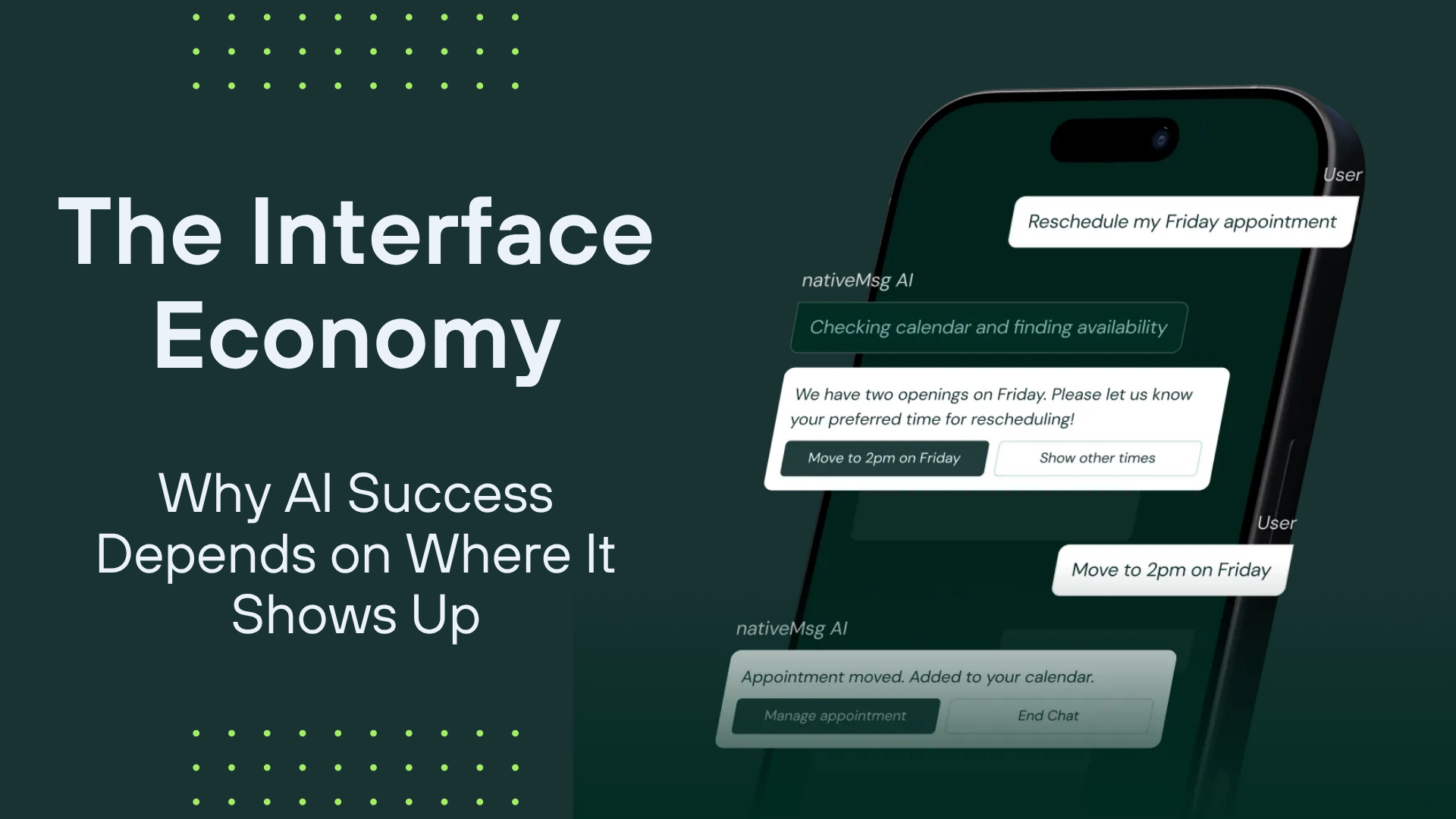
RCS for Business (Rich Communication Services) takes messaging a step further by transforming it into a rich, interactive interface. It enables:
- Visual, app-like experiences
- Buttons and structured interactions
- Real-time conversations
- Persistent threads
- Branded, trusted communication
This turns messaging into more than a channel. It becomes:
- A decision surface
- A transaction layer
- A continuous engagement interface
For AI, this is critical because it allows intelligence to move from a tool users seek out to an experience that meets users where they already are. This provides limitless potential for growth and acquisition, regardless of what industry you’re in.
From Tools to Interfaces
The biggest shift in AI isn’t just technological, it’s experiential. Our goal is to move AI from:
- A destination (apps, chatbots, tools)
To:
- An embedded layer across interfaces
This changes how value is created:
- It’s not just about answering questions
- It’s about shaping decisions
- Triggering actions
- Guiding outcomes in real time
And that only happens in the right interface.
What This Means for Your Business
AI success depends on:
- Being present at high-intent moments
- Reducing friction between insight and action
- Embedding AI into existing behaviors
This requires rethinking not just technology, but distribution as a whole. For companies investing in AI, the key question is no longer:
“What can our AI do?”
It’s:
“Where will our AI show up in the customer journey?”
That’s the question that makes all the difference.
Final Thoughts
AI will not be won by models alone, it will be won by distribution, interaction, and presence. The companies that succeed will be the ones that place AI:
- Closest to the customer (using RCS)
- Inside everyday workflows
- At the moment decisions are made
Because in the interface economy, the question isn’t just how smart your AI is, it’s where it shows up.
See It in Action
If you're thinking about how AI fits into your customer experience, the interface layer is where strategy meets execution.
Book a demo to learn how nativeMsg can help your brand bring AI into the messaging interface through RCS. We love helping organizations enable intelligent, interactive experiences that show up at the right moment and drive real outcomes.